The Hurricanes
It began in controversy. Some reports say the 1927 football team held a team meeting to select Hurricanes, hoping they would sweep away opponents just as the devastating storm did on September 16, 1926. Another version holds that Miami News columnist Jack Bell asked end Porter Norris of the 1926 team what the team should be called. Told that the local dignitaries and University officials wanted to name the team for a local flora or fauna, Norris said the players wouldn’t stand for it and suggested "Hurricanes" since the opening game had been postponed by such a storm. From time to time, opposition has arisen to the name that would "reinforce Miami’s negative reputation as a weather-beaten community living constantly under the threat of destruction." But as one University of Miami official rationalized in the 60’s, "Does anyone think Chicago is overrun by bears just because the town has a football team by that name?
 Sebastian the Ibis
Folklore maintains that the Ibis, a symbol of knowledge found in the Everglades and Egypt, is the last sign of wildlife to take shelter before a hurricane and the first to reappear after the storm. The local marsh bird was considered UM’s first unofficial mascot when the school yearbook adopted the name "Ibis" in 1926. Its popularity grew among the students during the 50’s. In 1957 San Sebastian Hall, a residence hall on campus, sponsored an Ibis entry in the homecoming celebration. The next year, student John Stormont performed at games in an Ibis costume that was glued, sewn and pinned together and was the forerunner of today’s bird. Through the years, the Ibis has become one of the most recognizable college mascots in the United States. Sebastian the Ibis is also a logo—a consistent graphic mark used on merchandise and other materials to represent Hurricanes identity and pride.
Four Fingers
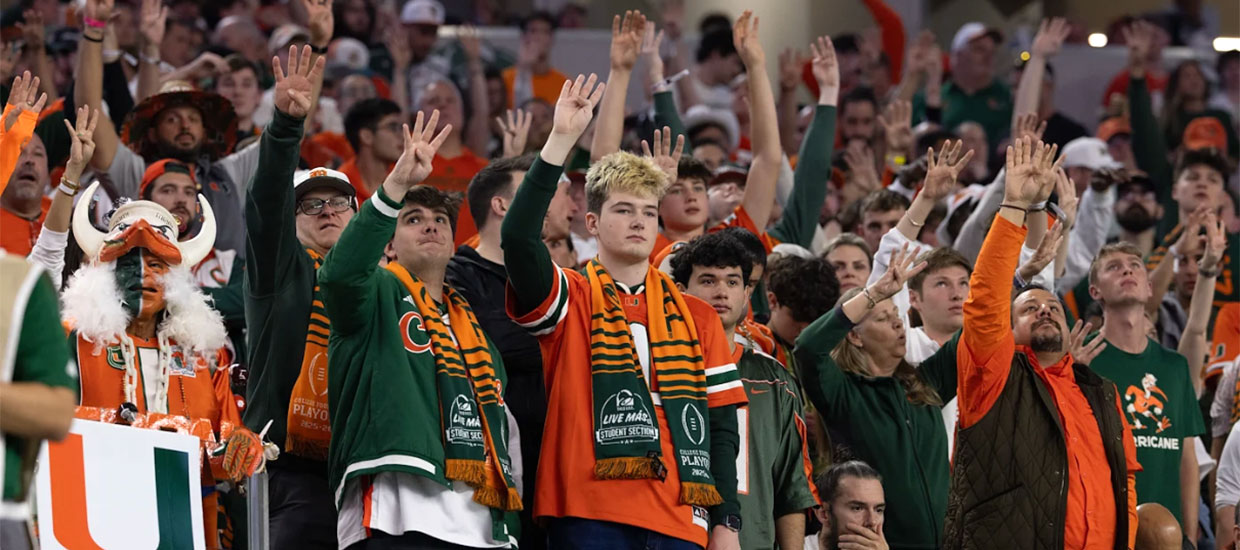
As the fourth quarter begins at a football game, Miami players and fans traditionally hold up four fingers. The sign indicates their belief that a game is won in that crucial final period. True Hurricane fans and players use the sign as a symbol that they own that last quarter.
Orange, Green and White
The University of Miami colors, selected in 1926, represent the Florida orange tree. Orange symbolizes the fruit of the tree, green represents the leaves and white, the blossoms.
 The U
The U
In 1973, the University’s Athletic Federation, the fundraising arm of the athletic department at the time, commissioned a local public relations expert to develop a distinctive logo. The University had gone several years with a variety of helmet and uniform changes, and the federation noted that a number of major colleges have the initials UM. Miami designer Bill Bodenhamer suggested the "U" idea, which lent itself to slogans like "U gotta believe" and "U is great".
In 2009 the University adopted the split-U logo as the centerpiece of its visual identity system.
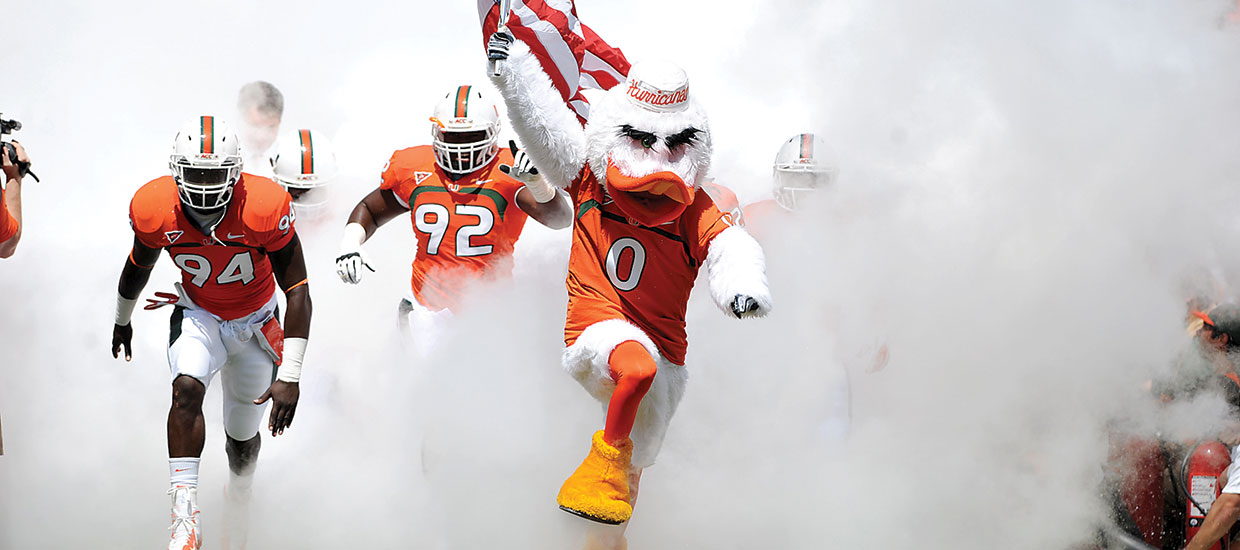
The "Smoke"
The traditional Hurricane "smoke" entrance in the Orange Bowl began in the 1950s. In an attempt to increase fan interest, UM transportation director Bob Nalette came up with the idea of using fire extinguishers to produce the now-famous smoke that Hurricanes run through as they enter the field. In his spare time 40 years ago, Nalette welded the pipe together that even today billow smoke from the top of the Hurricanes’ entrance tunnel. The original set up included flashing lights, two large hurricane flags and a tape of a hurricane being blasted over the loud speaker. The flags and lights are now gone but the smoke and sound track still remain.
Band of the Hour
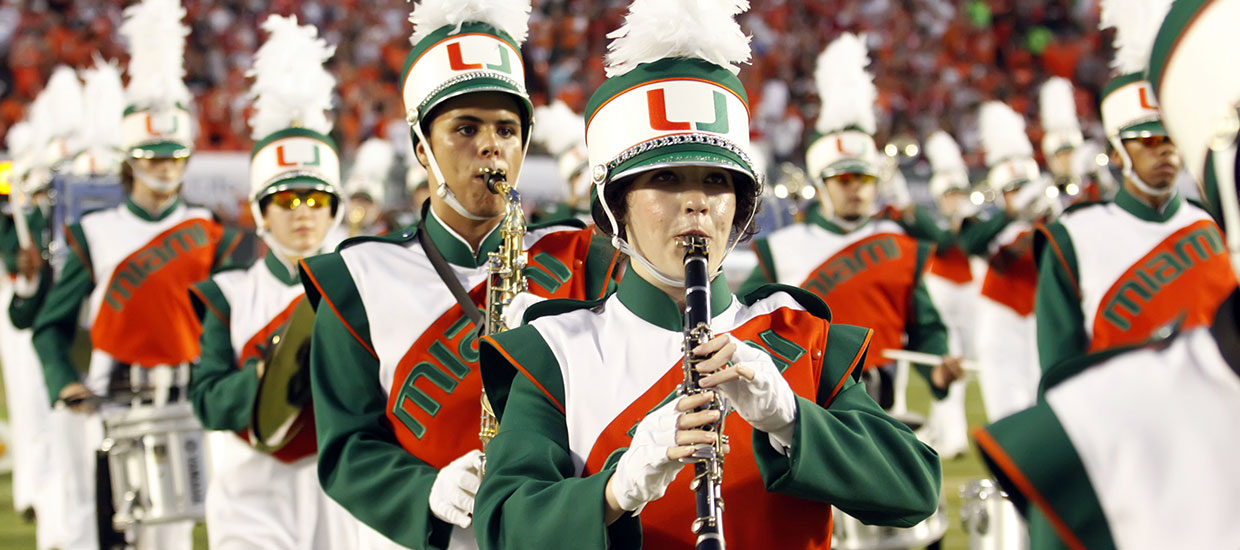
The "Band of the Hour" is the largest and most spirited student organization on campus. The University of Miami "Band of the Hour" is well-known for its pregame and halftime performances at Hurricane football games. It has been on television coast-to-coast and has served three times as host band for the American Bandmasters’ Association, a distinction held by no other college band. The "Band of the Hour" received its name in 1948 as it was playing Fillmore’s march, the "Man of the Hour" during a halftime performance in the Orange Bowl. The announcer spoke over the stadium public address, "The Man of the Hour played by the Band of the Hour!" The name caught on among students and the local press, and the band adopted it as its official title.
Iron Arrow
Founded in 1926 by University of Miami President Bowman Foster Ashe and student Francis Spencer Houghtaling, the Iron Arrow Honor Society is the highest honor one can attain at the University of Miami. The Iron Arrow ritual and tradition was established through a relationship with the Seminole Nation at its inception, and currently with the Miccosukee Tribe of Indians of Florida. Iron Arrow taps new members biannually based on the criteria of “Character, Leadership, Humility, Scholarship and Love of Alma Mater.” University of Miami students, faculty, staff, alumni and trustees are eligible.
War Canoe Trophy
An authentic Seminole war canoe, hand carved and painted by Seminole Indians from a 200-year-old Everglades cypress tree felled by lighting, was donated on behalf of the city of Hollywood in 1955 as a trophy for the annual football game between Miami and Florida. The canoe symbolized the magnificent spirit and fighting determination traditional of the independent Florida Seminole tribe that was displayed annually between the Hurricanes and Gators. Today the canoe is on display in the University's Sports Hall of Fame on campus.
Alma Mater
William “Bill” S. Lampe wrote the words to the song on the back of an envelope and an overdue bill from a printer. Gifted pianist Christine Asdurian, class of 1927, composed the music for the Alma Mater, forever linking their names to the University’s history. Read more.
Southern suns and sky blue water,
Smile upon you Alma mater;
Mistress of this fruitful land,
With all knowledge at your hand,
Always just to honor true,
All our love we pledge to you.
Alma Mater, stand forever
On Biscayne’s wondrous shore.
